
EV Charging Battery Fire Prevention
- David Pugh

- Apr 22
- 5 min read
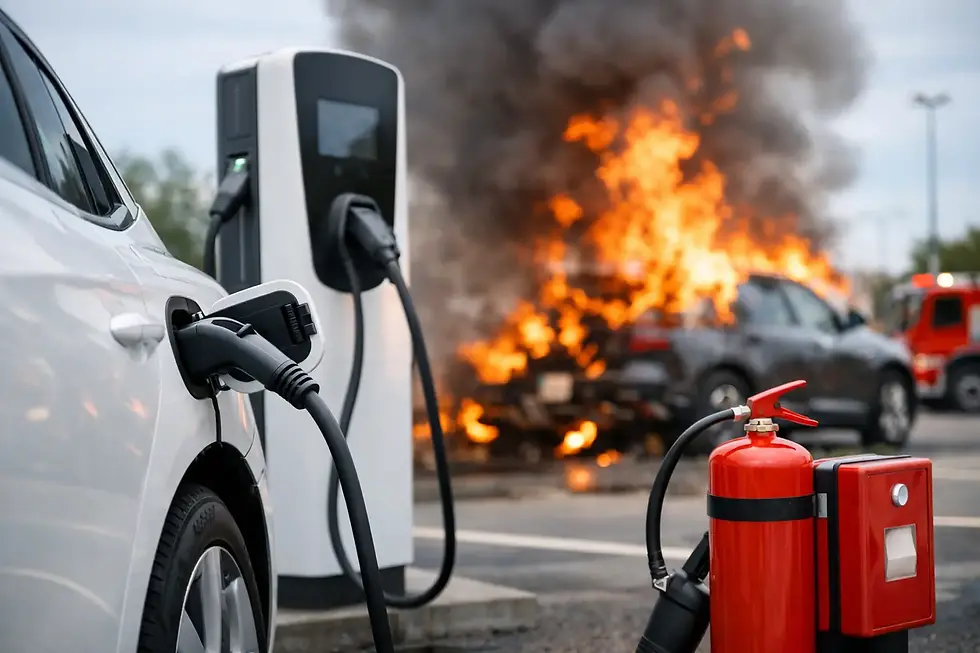
A charging bay can look normal right up to the point it is not. Cables are live, vehicles are connected, current is flowing, and the site appears stable. Yet in lithium-ion environments, failure does not begin with visible flame. Effective EV charging battery fire prevention starts earlier, with control of the conditions that allow a battery defect to escalate into thermal runaway.
For operators of EV charging infrastructure, that distinction matters. The risk profile is not limited to the vehicle battery alone. Charging cabinets, integrated storage, UPS-backed systems, switchboards, and enclosed electrical rooms can all contribute to the hazard landscape. Once a cell transitions into runaway, the incident moves quickly. Heat release intensifies, flammable gases accumulate, adjacent cells become involved, and the consequences shift from a manageable fault to a site emergency.
Why EV charging battery fire prevention must start before heat and flame
Battery fires are often discussed as if ignition is the first event worth detecting. In practice, ignition is late stage. Before that point, a failing lithium-ion cell can emit hydrogen and electrolyte vapours as internal chemistry breaks down. That off-gassing phase creates a valuable intervention window.
This is where many charging sites remain exposed. Conventional smoke detection, thermal cameras and heat detectors each have a role, but they generally respond after conditions have already deteriorated. In an EV charging environment, where equipment may be outdoors, semi-enclosed, or integrated into plant rooms with limited space, waiting for heat or smoke can leave too little time for operational response.
Early-stage gas detection changes the sequence. Instead of reacting to combustion, operators can identify abnormal battery behaviour while the event is still developing. That allows ventilation to start, chargers to isolate, alarms to activate and site personnel to respond before ignition risk increases. For critical assets, prevention is not a matter of faster firefighting. It is about earlier fault recognition.
The main failure pathways at EV charging sites
Not every charging installation carries the same level of battery risk. A simple AC charger in an open car park presents different conditions to a high-power DC fast charging hub with on-site battery storage and enclosed power conversion equipment. Still, the main failure pathways are consistent.
Cell manufacturing defects remain one source. Mechanical damage, poor installation practice, insulation failure, water ingress, contaminated connections and ageing can also destabilise battery systems over time. Charging itself can amplify these weaknesses, particularly where high currents, repeated duty cycles and elevated ambient temperatures are involved.
Australian conditions add another layer. High heat, dust, salt exposure in coastal sites and variable enclosure performance can all affect electrical integrity and thermal management. If ventilation is undersized or maintenance slips, small abnormalities can persist unnoticed. The issue is rarely one single cause. More often, incidents emerge from a chain of technical and operational factors that were never interrupted early enough.
What effective EV charging battery fire prevention looks like in practice
The strongest approach combines detection, automatic response and site-specific engineering controls. There is no single device that removes all risk. What works is a layered safety design built around how lithium-ion failure actually develops.
At the front end, early off-gas detection provides the first warning of cell distress. Sensors designed to identify hydrogen and electrolyte vapours such as DEC and DEMC can detect battery decomposition products before open fire occurs. That signal becomes more valuable when it is tied into site controls rather than treated as a standalone alarm.
A useful system can trigger staged responses. The first threshold might raise a local warning and notify operations. The next might command mechanical ventilation, reduce charger output or isolate affected equipment. At a higher threshold, the system can initiate emergency shutdown logic and escalate alarms through SCADA or BMS interfaces. The aim is to convert early chemical signs into practical action.
This matters especially for sites where uptime is commercially significant. Public charging networks, fleet depots, logistics hubs and transport interchanges cannot afford to rely on manual intervention alone. If a risk condition is detected at 2 am, the controls still need to respond.
Detection is only useful if the response is engineered
A common weakness in safety design is treating detection as the finish line. It is not. If a sensor alarms but no one knows what gets isolated, what fans start, or how the event is verified, then the site still carries unnecessary exposure.
For EV charging applications, response planning should define which loads trip, which relays activate, how ventilation behaves, where operators receive alarms and what evidence is logged. Integration with Modbus RTU or relay outputs can make this straightforward in modern infrastructure, but only if it is considered early in the design.
This is where specialist deployment matters. Detection technology has to be placed where gases are likely to accumulate or travel, not simply where it is convenient to mount hardware. Enclosure layout, airflow, charger arrangement and maintenance access all influence sensor performance.
Ventilation, isolation and separation still matter
Early detection does not replace fundamental engineering controls. It strengthens them. Ventilation remains critical in enclosed or partially enclosed charging infrastructure, particularly where battery storage or power electronics are housed in cabinets, containers or plant rooms. If off-gassing occurs, reducing concentration and preventing accumulation can materially change the outcome.
Electrical isolation is equally important. In a developing battery fault, keeping energy flowing into the problem can worsen it. Charging equipment should be capable of staged or emergency shutdown based on alarm logic. That may involve isolating a charger, disconnecting an associated battery system, or shutting down a room or zone depending on the site architecture.
Physical separation also deserves more attention than it often receives. Tight layouts are commercially attractive, especially in retrofit projects, but dense equipment placement can increase escalation risk. Where one cabinet, charger or battery module fails, spacing and barriers can help prevent adjacent assets from becoming involved.
Compliance is not the same as protection
Many operators ask what standard or code requirement applies, and that is a reasonable starting point. Compliance provides a baseline. It does not guarantee that a charging site has meaningful early warning for battery failure.
The gap usually appears in mixed environments. A site may technically satisfy electrical and fire requirements while still lacking detection for the off-gassing phase that precedes ignition. That is especially relevant in newer charging formats where high-energy equipment, integrated storage and constrained footprints sit together.
A better question is whether the design can identify a failing battery before heat and flame dominate the event. If the answer is no, then the site may be compliant yet still operationally vulnerable. For Australian infrastructure owners, that vulnerability has commercial consequences as much as safety consequences. Asset damage, outage duration, insurer scrutiny and reputational impact all sit downstream of the same design decision.
Where operators should focus first
For existing sites, the practical starting point is a risk review rather than a wholesale redesign. Identify where lithium-ion assets are present, where charging loads are concentrated, which spaces are enclosed, and how alarms currently escalate. Many sites already have fire protection, but far fewer have intelligent early detection targeted at battery off-gassing.
For new projects, battery fire prevention should be designed in from the beginning. Sensor placement, wiring pathways, control logic, ventilation interfaces and SCADA integration are easier and more cost-effective when they are part of the original engineering package. Retrofitting later is possible, but it usually involves more compromise.
It also pays to be realistic about trade-offs. Not every charger warrants the same treatment. Open-air low-power installations may justify a different control philosophy to enclosed fast-charging hubs or sites with co-located battery storage. The right design depends on energy density, enclosure conditions, consequence of failure and required continuity of service.
In higher-risk applications, intelligent early detection is no longer a nice-to-have. It is the difference between recognising battery failure as a controllable event or discovering it once emergency response is already under way. That is why engineered systems built around off-gassing detection, automated ventilation, isolation logic and site integration are becoming central to modern EV charging safety strategy. For operators looking at long-term resilience, the most valuable protection is the one that gives you time to act.


Comments