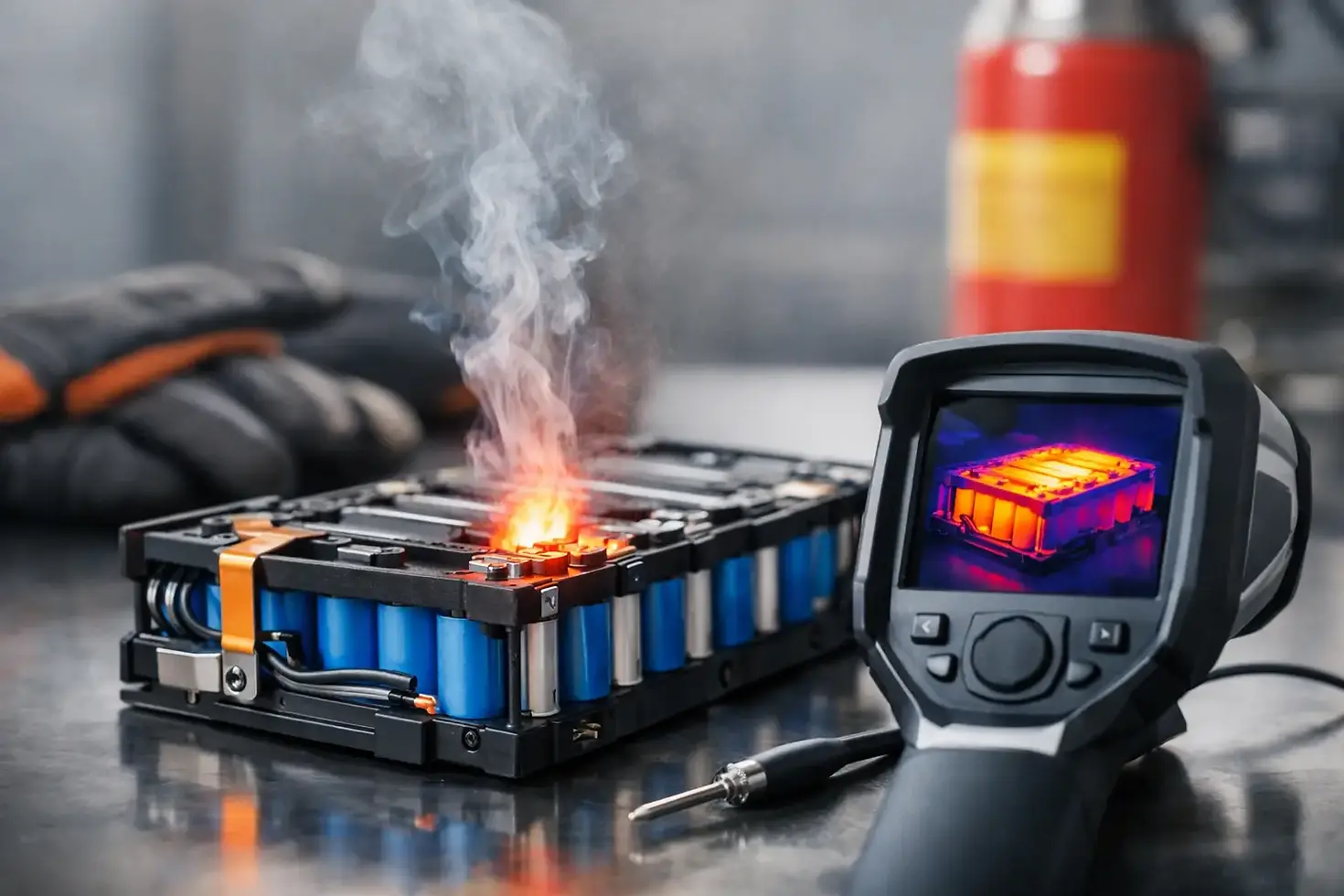
How to Reduce Thermal Runaway Risk

A lithium-ion battery fire rarely starts at the point operators can see it. By the time heat, smoke or flame is visible, the failure is already well advanced. That is why understanding how to reduce thermal runaway risk matters so much in BESS enclosures, UPS rooms, EV charging infrastructure and battery manufacturing spaces. The safest response begins well before ignition, at the first signs of cell distress.
Why thermal runaway risk is difficult to manage
Thermal runaway is not a single event. It is a failure progression in which a battery cell moves from internal fault to heat generation, petrol release, venting, and potentially fire or explosion. In lithium-ion systems, this chain can escalate quickly, particularly where high energy density, confined spaces and limited ventilation combine.
The challenge for operators is that conventional fire detection is usually too late to provide meaningful intervention. Smoke detectors and heat detectors are valuable parts of a wider protection strategy, but they are not designed to identify the earliest electrochemical warning signs inside a failing cell. Once visible smoke appears, the window for controlled action may already be narrowing.
This is where many projects still carry an exposure gap. They may have suppression, alarms and shutdown procedures in place, yet lack a dedicated method for detecting the petrols released before ignition. For critical infrastructure, that gap can translate directly into downtime, asset damage, safety incidents and difficult compliance conversations after the fact.
How to reduce thermal runaway risk at the earliest stage
If the goal is to reduce consequence, the first priority is earlier detection. Lithium-ion cells often emit hydrogen and electrolyte vapours such as DEC and DEMC during the onset of failure, before flames or heavy smoke develop. Detecting these off-petrols provides a practical opportunity to trigger ventilation, isolate affected circuits, raise alarms and initiate operator response while the event is still more manageable.
This approach shifts protection from reactive to preventative. Instead of waiting for combustion indicators, facilities can act on chemical evidence of battery distress. In operational terms, that can mean more time to contain the issue, fewer propagated failures across adjacent racks or cabinets, and a better chance of preserving uptime.
Not every site needs the same response logic. A utility-scale BESS may require automatic HVAC control, SCADA notification and staged shutdown. A data centre battery room may prioritise alarm escalation and selective isolation to protect continuity. An EV charging hub may need a compact detection layer in constrained plant areas. The principle is the same, but the control sequence should reflect the asset, occupancy, ventilation profile and consequence of interruption.
System design still matters
Early detection is powerful, but it is not a substitute for sound engineering. Any serious answer to how to reduce thermal runaway risk has to include battery system design, installation quality and operational discipline.
Cell chemistry selection affects baseline risk. Different chemistries present different thermal characteristics, vent petrol profiles and propagation behaviour. That does not mean one chemistry eliminates the problem. It means design teams should avoid broad assumptions and assess hazard characteristics at project level.
Mechanical layout is equally important. Tight rack spacing, poor cable management, inadequate segregation and limited service access can all complicate thermal behaviour and emergency response. Ventilation design needs similar scrutiny. If off-petrols cannot disperse or be extracted effectively, a minor venting event can become a larger enclosure hazard.
Battery management systems play a central role, but they also have limits. Voltage, current and temperature monitoring are essential, yet BMS data alone may not catch every internal fault early enough. A cell can enter distress before external temperature shifts become obvious at rack level. For that reason, relying on one layer of monitoring is rarely the strongest risk position.
Detection should connect to action
A detector only adds real value when it is integrated into a response framework. In practice, this means defining what happens when off-petrol thresholds are reached, who receives the alarm, what equipment changes state and how the event is investigated.
For industrial operators, relay outputs and Modbus RTU compatibility are not convenience features. They are what allow early-stage petrol detection to work as part of a complete protection architecture. A detector that can communicate with SCADA, BMS-adjacent controls or site automation makes it possible to automate time-critical actions instead of relying solely on human interpretation under pressure.
Those actions might include starting forced ventilation, isolating charging circuits, shutting down affected containers, escalating alarms to remote monitoring or triggering site-specific emergency procedures. The right sequence depends on the facility. Full shutdown is not always the best first move if it creates secondary operational risk. On some sites, controlled derating and local investigation may be more appropriate than immediate system-wide isolation. The correct answer depends on consequence modelling, site design and emergency planning.
Installation strategy affects detection performance
Detector performance is not only about the sensor. Placement matters. Off-petrol monitoring should be positioned where vented compounds are most likely to accumulate or pass during the early stages of failure. That may be within cabinets, near ceiling zones in enclosed battery rooms, in return air paths, or in containerised systems where airflow patterns are predictable.
Too often, petrol detection is treated as a generic add-on and mounted where space happens to be available. That can reduce response time or create blind spots. A better approach is to map likely petrol movement, enclosure geometry, HVAC behaviour and maintenance access before installation.
Serviceability also matters in live infrastructure. Compact form factors are useful in constrained electrical rooms and packaged systems, but accessibility should not be sacrificed. Detection equipment needs to remain inspectable, testable and visible within the broader safety regime.
Maintenance, testing and operational readiness
Reducing thermal runaway risk is not a one-off procurement exercise. It is an operational discipline. Detection systems, alarms, ventilation controls and shutdown logic all need routine verification. If a relay output fails, if a SCADA point is mis-mapped, or if a ventilation sequence has been overridden during unrelated works, the protection concept weakens quickly.
This is particularly relevant in facilities where contractors, controls technicians and electrical teams work across different scopes. Change management should cover battery safety interfaces explicitly. A small modification in building services or control logic can have unintended consequences for battery hazard response.
Training matters as well. Operators should know what an off-petrol alarm means and how it differs from a fire alarm. The response to early chemical warning signs is often more controlled and more technical. Staff need clear procedures for verification, isolation, escalation and re-entry conditions. Without that, even a well-engineered system can be undermined by hesitation or inconsistent decisions.
Where early detection delivers the most value
The strongest business case for early detection usually appears in assets where interruption is expensive and consequence extends beyond equipment replacement. That includes grid-scale storage, data centres, UPS-backed facilities, EV charging depots and manufacturing environments with high production dependency.
In these settings, the question is not only how to prevent fire. It is how to protect continuity, maintain safe access, avoid propagation and preserve evidence for fault diagnosis. Earlier warning supports all four. It gives operations teams more options before the event becomes a full emergency.
That is why specialist off-petrol detection has become an increasingly important layer in lithium-ion safety strategies. Solutions built to detect hydrogen and electrolyte vapours at the pre-ignition stage can support a more controlled response, particularly when combined with local technical support, compliance-focused deployment and proper system integration. For Australian operators managing critical infrastructure, that level of engineered energy protection is becoming harder to ignore.
A practical view of how to reduce thermal runaway risk
If you want a practical answer to how to reduce thermal runaway risk, start by assuming that no single safeguard is enough. Good battery design, competent installation, ventilation, BMS oversight, emergency planning and fire protection all have a role. But if early warning is missing, the entire strategy is forced to react later than it should.
The most resilient sites treat off-petrol detection as an intervention point, not just another alarm. They use it to buy time, trigger controls and reduce the chance that a single failing cell becomes a site-wide incident. In high-energy environments, that extra time is often the difference between an operational event and a major loss.
For asset owners and project teams, the smarter question is not whether thermal runaway can occur. It is whether your site is engineered to recognise the first warning signs early enough to do something useful about them.


Comments