
Best BESS Hazard Detection Methods for Early Warning
- David Pugh

- Jul 16
- 6 min read
A BESS incident rarely begins with visible flame. Long before that point, a compromised cell can generate hydrogen and electrolyte vapours, experience abnormal heating, and create local conditions that conventional fire detection may not see. The best BESS hazard detection methods are therefore those that identify these early failure signatures quickly enough for operators to isolate equipment, protect personnel and prevent escalation.
For asset owners, EPCs and facility managers, the right answer is not a single detector. It is a coordinated detection strategy designed around battery chemistry, enclosure design, ventilation, operating duty, control architecture and emergency response procedures. Each detection method sees a different part of the failure pathway. The practical goal is to close the gaps between them.
Why early-stage detection changes the BESS risk equation
Thermal runaway is a self-heating failure process that can lead to rapid cell venting, fire, explosion risk and damaging propagation to adjacent cells or racks. Once smoke, flame or a rapid temperature rise is apparent, the available intervention window may be very limited.
Early warning shifts the response window upstream. A well-designed system can identify abnormal gas generation or local heat development while there is still time to stop charging or discharging, isolate a rack, increase ventilation where appropriate, investigate the affected equipment and activate site-specific emergency controls. This also protects continuity of supply. A contained event in one string is operationally different from a container-level outage, fire response and extended asset loss.
Detection should support, rather than replace, the battery management system (BMS), fire suppression, ventilation and emergency planning. A BMS monitors electrical and cell-level operating parameters. Hazard detection provides an independent environmental view of what may be occurring within the enclosure or room.
The best BESS hazard detection methods work in layers
Off-gas detection for the earliest warning
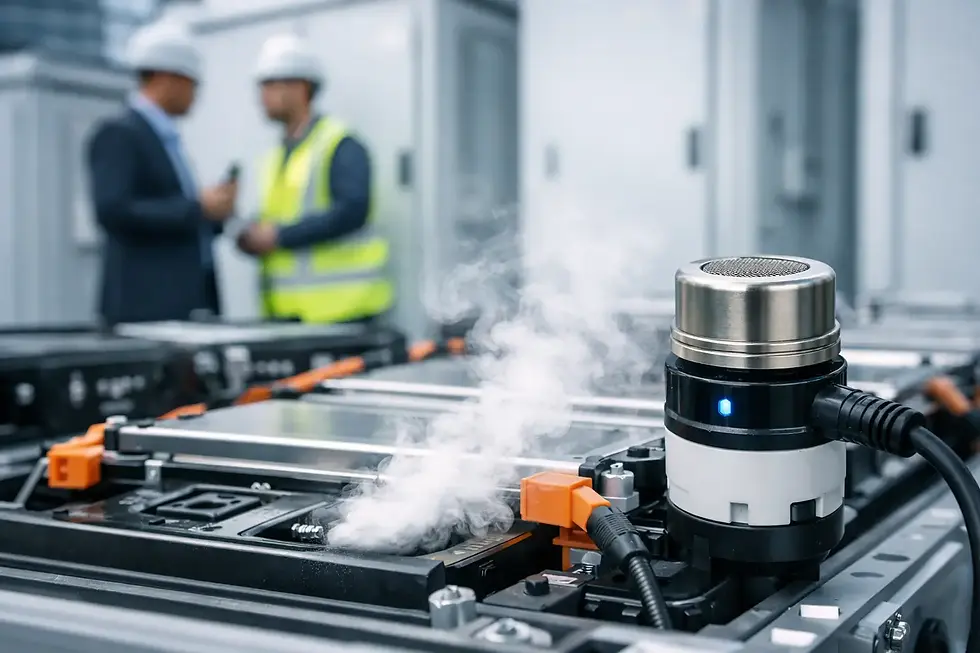
Off-gassing detection is often the most valuable early-warning layer for lithium-ion BESS applications. Cells entering an abnormal failure condition may release gases and electrolyte-related vapours before there is smoke or flame. Depending on the chemistry and failure mode, relevant indicators can include hydrogen, volatile organic compounds (VOCs) and electrolyte vapours.
Unlike a conventional smoke detector, an off-gas detector is intended to identify precursors to a visible fire event. This distinction matters in enclosed battery containers, switchrooms, UPS rooms and other installations where minutes of additional warning can materially improve the response.
Sensor selection should be based on the failure signatures relevant to the battery technology and the enclosure. Multi-parameter systems offer a stronger picture than a single-gas approach because they can correlate hydrogen and VOC activity with humidity and temperature changes. This helps distinguish a developing battery fault from a short-lived environmental fluctuation.
Placement is critical. Gas movement is influenced by enclosure geometry, cabinet layout, air-conditioning, mechanical ventilation, pressure relief paths and stagnant zones. Sensors should be positioned through a considered sampling and airflow assessment, not simply mounted where cable access is easiest. In larger containers, one detector at the door may be insufficient to identify an event developing at the opposite end of a rack line.
Temperature monitoring and thermal imaging
Temperature sensing remains essential, particularly at cell, module, rack and connection levels. It can reveal abnormal heating caused by a loose high-resistance connection, cooling failure, overcurrent condition or a developing internal battery fault. BMS temperature data is useful, but additional independent sensors can provide valuable verification for critical assets.
Fixed thermal monitoring is most effective where sensor locations can be targeted at known hotspots. Thermal cameras can provide broad visual coverage of cabinets, busbars and ancillary equipment, making them useful for detecting abnormal surface temperature patterns. They are particularly valuable around power conversion equipment and electrical connections, where an electrical fault may create a fire risk independent of the battery cells.
The trade-off is that surface temperature does not always reflect what is happening deep inside a module. Thermal imaging can identify a consequence of a problem, but it may not provide the earliest indication of internal cell venting. It should be treated as a complementary method, not the sole thermal-runaway warning system.
Smoke and aspirating smoke detection
Smoke detection is a recognised and necessary part of most fire detection strategies, but it is later in the failure sequence than off-gas sensing. Spot smoke detectors can be affected by airflow, dust, humidity and the physical distance between the source and detector. In ventilated BESS containers, smoke may disperse or be directed away from a detector before an alarm threshold is reached.
Aspirating smoke detection can improve sensitivity by actively drawing air through sampling pipes from multiple locations. It is well suited to controlled indoor battery rooms and high-value infrastructure where early smoke recognition remains an important layer. However, it still depends on particulate matter being present. It cannot be relied upon to detect the invisible gases released in the earliest stages of many lithium-ion failures.
Flame detection for rapid escalation recognition
Infrared and ultraviolet flame detectors can recognise flames quickly when they have a clear line of sight. In BESS applications, they can form a useful escalation layer, particularly in larger enclosures or outdoor installations where a fire must trigger immediate alarms, shutdown actions and emergency response procedures.
Their limitation is straightforward: a flame detector detects flame. It is not an early-warning tool for a battery entering thermal runaway. Obstructions, enclosure geometry and direct sunlight can also influence design and detector selection. Use flame detection to confirm a severe event and initiate decisive controls, not as the first line of defence.
Electrical and BMS analytics
The BMS is central to safe battery operation. Voltage deviation, cell imbalance, unexpected current behaviour, state-of-charge anomalies, insulation faults and internal temperature trends can signal conditions that deserve attention. At site level, SCADA and energy management systems can combine this information with detector alarms, inverter status, HVAC data and door contacts.
Electrical analytics are especially useful for identifying patterns over time and validating whether an environmental alarm aligns with changing battery behaviour. However, a BMS cannot see every failure pathway. A localised defect can progress quickly, sensor readings can be limited by their position, and a single cell failure may not immediately create an obvious pack-level electrical anomaly. Independent gas and environmental detection adds resilience.
Build alarms around decisions, not just thresholds
A detector creates value only when its signal produces a timely, defined action. Alarm philosophy should be agreed before commissioning and integrated with the site’s operating procedures. A single low-level gas alert should not necessarily trigger a full site evacuation, but it should create a recorded event, notify the responsible team and prompt assessment of BMS data, ventilation status and affected battery zones.
A higher-confidence alarm - for example, elevated hydrogen or VOC readings combined with abnormal temperature behaviour - may justify automatic actions. Depending on the system design and manufacturer requirements, these can include stopping charge and discharge, opening contactors, isolating a rack, increasing mechanical ventilation, closing access, issuing SCADA alarms and notifying emergency response personnel.
Avoid designing solely around nuisance-alarm reduction. Excessive filtering or prolonged alarm delays can remove the early-warning advantage the system was installed to provide. The better approach is staged alarm logic that uses trends, sensor correlation and clear escalation thresholds.
Integration and maintainability are procurement requirements
For a BESS operator, a standalone alarm with no connection to the control environment creates unnecessary risk. Detection equipment should integrate cleanly with existing systems using relay outputs and, where needed, Modbus RTU or another appropriate communications protocol. Operators need clear indication of detector status, fault conditions, alarm levels and the physical zone affected.
The installation also needs to suit the practical realities of battery projects. Enclosures can be constrained, cable pathways are limited, and access after commissioning may be difficult. Compact detector form factors, sensible service access and long-life sensor performance can lower whole-of-life burden. Maintenance requirements should be documented in the asset plan, including bump testing or calibration where specified, functional testing of alarm outputs and inspection of sampling paths or filters.
For Australian projects, design teams should also align detection, emergency controls and documentation with applicable fire engineering, electrical safety, planning and insurer requirements. Compliance is not a box-ticking exercise. It is the evidence that detection and response arrangements can perform as intended under site conditions.
A practical detection architecture for critical BESS assets
A high-value battery installation will commonly combine off-gas detection, BMS analytics, temperature monitoring and smoke or flame detection. Off-gas sensing provides early warning of chemical failure signatures. Temperature and electrical data provide corroboration and fault context. Smoke and flame detection identify escalation and support the emergency response layer.
NexaGuard Systems supplies the Evikon E2673 industrial off-gassing detection system for this early stage of the risk pathway, detecting hydrogen, VOCs, electrolyte vapours, humidity and temperature changes associated with failing lithium batteries. With relay outputs and Modbus RTU compatibility, this type of system can be incorporated into SCADA-based alarm and control strategies rather than operating as an isolated device.
The final design should remain site-specific. A utility-scale container exposed to high ambient temperatures needs a different sensor layout and alarm strategy from an indoor UPS room or a commercial battery cabinet. Battery chemistry, ventilation rate, occupancy, rack spacing and emergency access all change the risk profile.
The most useful question is not, “Which detector is best?” It is, “How early can this site recognise a credible battery failure, and what will happen in the minutes after that alarm?” When those answers are engineered before commissioning, early warning becomes a practical layer of protection rather than a last-minute alarm.


Comments