
DEC DEMC Vapour Detection for Battery Safety
- David Pugh

- 6 days ago
- 6 min read
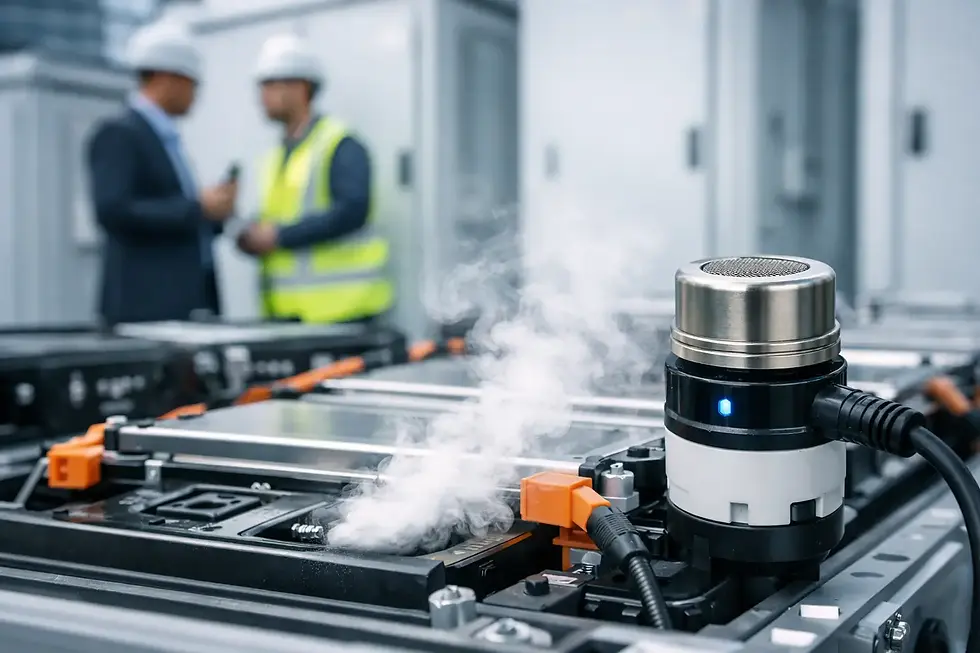
A lithium-ion cell does not need to be on fire to present a serious operational risk. Long before visible smoke, flame or a sudden temperature rise, a failing cell can vent electrolyte vapours and gases into its enclosure. DEC DEMC vapour detection is therefore a critical early-warning consideration for battery energy storage systems, UPS rooms, EV charging infrastructure and other high-consequence battery installations.
For asset owners and safety teams, the objective is not simply to confirm that thermal runaway has occurred. It is to identify the precursor event early enough to isolate equipment, investigate the affected zone and activate an emergency response before the incident escalates.
What DEC and DEMC vapours indicate
DEC commonly refers to diethyl carbonate, an organic carbonate solvent used in lithium-ion battery electrolyte formulations. DEMC terminology can vary between suppliers and chemical documentation, so the exact solvent identity should always be confirmed against the battery chemistry and its safety data sheet. In practice, DEC and related electrolyte carbonate vapours are part of the volatile organic compound, or VOC, signature associated with electrolyte leakage, cell venting and internal battery failure.
A lithium-ion battery contains a liquid electrolyte designed to carry ions between electrodes. Under abuse conditions such as overcharging, internal short circuit, mechanical damage, manufacturing defects or excessive heat, the cell may begin to decompose internally. Pressure rises, seals can fail and a mix of vapours, aerosols and gases can be released.
That release may include electrolyte vapours, VOCs, hydrogen and other decomposition products. The precise mixture depends on cell format, state of charge, cathode chemistry, age, temperature and failure mode. This is why an early-warning strategy should not be built around one assumed chemical alone.
A system designed for battery off-gas monitoring should recognise the broader evidence of deterioration: hydrogen and electrolyte vapours, changes in VOC concentration, humidity shifts and abnormal temperature conditions. Together, these indicators provide a more useful picture than relying on heat or smoke detection as the first warning point.
Why DEC DEMC vapour detection matters before smoke
Smoke detection remains necessary in battery installations, but smoke is generally a late-stage indicator. By the time smoke reaches a detector, a cell event may already be advanced, and available intervention time may be limited.
Electrolyte vapour detection operates earlier in the failure sequence. When a compromised cell vents, vapours can build within a cabinet, container, battery room or rack enclosure before combustion occurs. Detecting that release can give operators time to assess the alarm, isolate charging or discharge pathways, shut down affected equipment where appropriate, restrict access and escalate to emergency services under the site response plan.
For a BESS operator, this early interval can protect more than the battery asset. It can reduce the likelihood of a prolonged outage, damage to adjacent containers, loss of generation revenue, reputational harm and disruption to critical loads. In a data centre or UPS environment, the value is equally clear: early warning supports controlled decision-making rather than an unplanned response to a fire event.
Detection is not a guarantee that thermal runaway will be prevented in every scenario. A rapidly developing internal fault can progress quickly. However, an engineered off-gas detection layer materially improves situational awareness where conventional fire detection may provide insufficient lead time.
Detecting a battery failure signature, not just one solvent
The practical challenge with DEC DEMC vapour detection is selectivity. Electrolyte solvent vapours may be present at low concentrations, may disperse differently according to enclosure ventilation, and may coexist with other VOC sources. Cleaning products, coatings, lubricants, cable materials and nearby industrial processes can all affect background readings.
For this reason, specifying a detector solely on its ability to identify a named solvent can be misleading. What matters is whether the sensing approach is suitable for the expected battery off-gas signature, alarm thresholds, environmental conditions and control philosophy of the installation.
Industrial off-gas systems such as the Evikon E2673 are designed to monitor multiple early-stage indicators associated with lithium battery failure. This includes hydrogen, VOCs and electrolyte vapours, alongside humidity and temperature changes. The benefit of this multi-parameter approach is that it helps distinguish a developing battery event from a single isolated environmental change.
The alarm logic also needs to be considered carefully. A low-level pre-alarm may trigger investigation and increased monitoring, while a higher alarm can initiate automated actions through relay outputs or a building management system. For larger or remotely operated sites, Modbus RTU compatibility enables integration with SCADA platforms, site control systems and central alarm management.
Installation location determines detection performance
Even an advanced detector cannot provide meaningful early warning if it is installed in the wrong location. Vapours and gases must reach the sensing point, and that depends on the battery enclosure design, air movement, extraction systems, cable penetrations and the likely vent path from a failing cell.
In rack-based BESS systems, detection is often most effective when positioned close to the battery modules or within the enclosure airflow path. In a containerised installation, the approach may involve monitoring selected zones, air return paths or purpose-designed sampling points. The right arrangement depends on whether the objective is to identify an event within a particular rack, provide container-level warning or both.
Ventilation introduces a genuine trade-off. Strong airflow can dilute vapours before they reach a detector, yet insufficient ventilation can allow flammable gases to accumulate. Detection design should therefore be coordinated with the mechanical ventilation strategy, battery manufacturer guidance, fire engineering requirements and the site’s emergency response procedures.
For constrained spaces such as UPS rooms, EV charging plant rooms and battery manufacturing enclosures, compact devices with straightforward mounting and low maintenance requirements are particularly valuable. However, compact size should never override accessibility for inspection, functional testing and service verification.
Commissioning should establish a credible baseline
A newly installed system should not be treated as fit-for-purpose solely because it powers on and communicates with SCADA. Commissioning needs to verify sensor operation, alarm relays, communications, annunciation, control-system response and the physical location of each detector.
It should also establish normal operating conditions. Temperature, humidity and ambient VOC levels can vary over time, particularly in industrial facilities. Understanding the baseline helps operators investigate abnormal trends without creating a nuisance-alarm problem that staff eventually ignore.
Alarm thresholds should be based on the detector capability, enclosure volume, ventilation rate, battery chemistry, risk assessment and the practical time required for personnel to respond. Generic setpoints may be a starting point, but they are not a substitute for site-specific engineering.
Integrating detection into the response plan
An off-gas alarm has value only when it leads to a clear action. Facility managers, operators and emergency responders should know what a pre-alarm means, who receives it and what decisions are authorised.
For example, a staged response may call for remote verification at the first alarm, followed by controlled shutdown of the affected battery string or charger at a confirmed high alarm. It may include ventilation changes, access restrictions, thermal imaging, notification of the battery integrator and escalation to emergency services if conditions worsen. The correct sequence will vary by site and must not compromise electrical safety or emergency access.
In critical infrastructure, automatic actions require particular care. Immediate shutdown may protect equipment in some scenarios, but it may also affect service continuity or remove systems needed for safe operation. This is why detection, isolation logic and operational continuity planning must be developed together rather than as separate workstreams.
Choosing an early-warning solution for Australian sites
Australian BESS and industrial battery projects face a broad range of operating environments, from hot, dry inland sites to humid coastal facilities. Temperature range, dust exposure, enclosure classification, power supply, communications protocol and service access should all form part of procurement assessment.
Decision-makers should also ask whether the system supports practical integration. Maintenance-free operation and long service life can reduce the burden on site teams, while relay outputs and Modbus RTU allow alarms to be actioned through existing infrastructure. Local technical support is equally relevant when a project requires detector placement advice, commissioning assistance or coordination with a fire engineer and electrical contractor.
NexaGuard Systems supports this early-warning approach with battery-focused off-gas detection designed to identify developing hazards before smoke and fire occur. For high-value battery assets, the purpose is simple: detect the change that matters while there is still time to act.
The most effective battery safety strategy treats DEC, DEMC and related electrolyte vapours as an early signal, not an afterthought. When detection is correctly specified, positioned and connected to a tested response plan, it gives operators a practical advantage at the moment when seconds can still protect people, property and continuity of service.


Comments