
How to Detect Battery Venting Early
- David Pugh

- May 5
- 5 min read
A lithium-ion battery room rarely gives you much time. By the time heat, smoke or flame is visible, the failure event is already well advanced. That is why knowing how to detect battery venting matters in BESS enclosures, UPS rooms, EV charging infrastructure and battery manufacturing environments. The earliest actionable warning is often not temperature rise or smoke - it is off-petrol release.
Why battery venting is the earliest practical warning
Battery venting occurs when a cell under stress releases internal petrol and electrolyte vapours through its safety mechanism or as part of a fault condition. In lithium-ion systems, this can happen before ignition and before full thermal runaway propagates through a rack or container.
For operators of critical infrastructure, that timing difference is not academic. Early detection can create a response window to start ventilation, isolate affected equipment, trigger alarms through SCADA or BMS interfaces, and move site personnel into a controlled incident workflow. Once a battery fire has developed, your options narrow quickly and the operational consequences become far more severe.
The challenge is that venting is not always obvious to the human senses. In some installations, there may be no visible sign at all in the early stage. In others, the first clue may be a faint solvent-like odour, but relying on people to notice that in a noisy plant room or enclosed container is neither consistent nor safe.
How to detect battery venting in real operating conditions
If the goal is meaningful early warning, detection has to focus on the petrol and vapours associated with battery failure, not just the late-stage effects. That usually means monitoring for hydrogen and electrolyte vapours released during abnormal cell behaviour.
Petrol detection is more effective than waiting for smoke or heat
Traditional fire protection layers still have an important role, but they are not designed to identify the first chemical signs of battery distress. Smoke detection usually responds after decomposition products increase enough to create airborne particulates. Heat detection is later again, particularly in large enclosures where thermal build-up may remain localised in the early stage.
By contrast, dedicated off-petrol detection is intended to identify battery failure precursors. Sensors positioned in the battery environment can detect hydrogen and electrolyte compounds such as DEC and DEMC before a fault escalates to fire. That gives operators a chance to intervene earlier, which is the core advantage.
This is also where application detail matters. A data centre UPS room, for example, has different airflow patterns and enclosure geometry from a utility-scale battery container. Sensor placement, ventilation control logic and alarm thresholds need to reflect the actual site conditions rather than a generic specification.
What battery venting can look and smell like
In some events, battery venting presents with a sharp chemical or solvent odour. Depending on the chemistry and severity, there may be a haze, pressure release, or localised heating around a module. You may also see abnormal BMS data such as cell voltage deviation, temperature divergence or fault codes around a specific string.
Still, these signs are not reliable as a primary detection method. Odour is subjective. Visual evidence may not appear early enough. BMS information can be valuable, but it depends on what is being monitored and whether the fault has progressed far enough to produce a measurable electrical or thermal anomaly.
That is why engineered petrol detection has become the preferred safety layer where early intervention is the objective.
Which technologies help detect battery venting
The most effective approach is layered detection, but not all layers provide the same warning time.
Off-petrol detectors
Purpose-built off-petrol detectors are designed to identify the compounds associated with early battery failure. In lithium-ion applications, this commonly includes hydrogen and electrolyte vapours. These detectors are used in battery cabinets, BESS containers, switchrooms, charging infrastructure and manufacturing areas where early chemical release is the clearest indicator of risk.
For industrial operators, the practical value is not just sensing. It is what the device can trigger next: local alarms, relay-based shutdown actions, ventilation start, fan boost, SCADA notifications and incident escalation procedures. A detector without integration is only part of the solution.
Smoke and heat detection
Smoke and heat detection remain necessary for life safety and fire response, but they should be treated as downstream indicators in lithium-ion risk management. They are essential layers, just not the earliest ones. Relying on them alone means accepting a smaller response window.
BMS and condition monitoring
Battery management systems can identify electrical imbalance, over-temperature and operational faults. They are critical to battery control and asset protection, but they do not directly detect vented petrol. In practice, BMS data and off-petrol detection work best together. One tells you the system is behaving abnormally, the other tells you a cell may already be chemically failing.
How to deploy detection so it actually works
Knowing how to detect battery venting is partly about sensor technology and partly about engineering discipline. The detector must be installed where released petrol is likely to accumulate or pass, and the response logic needs to be matched to the site risk profile.
Placement matters more than many projects allow for
In a compact battery cabinet, sensor positioning may be relatively straightforward. In a larger BESS enclosure, airflow, extraction paths, rack layout and dead zones can all influence detection speed. If a detector is mounted for convenience rather than petrol behaviour, early warning performance can be compromised.
There is no single universal mounting point. Some sites benefit from detection near cabinet exhaust paths or high-risk module zones. Others need area coverage designed around forced ventilation and container geometry. This is where site-specific design pays off.
Integration should drive action, not just awareness
A venting alarm should connect to operational controls. Depending on the installation, that may include ventilation start-up, equipment isolation, remote alarm transmission, BMS interlock or escalation to a staffed control room. Modbus RTU and relay outputs are especially useful in industrial environments because they allow clean integration into existing SCADA and control architectures.
The right sequence depends on the asset and its operating constraints. Automatic shutdown may be appropriate in one installation and operationally disruptive in another. The point is to define the response before an event, not during one.
Limits, trade-offs and what not to rely on
There is no single detector that removes all battery risk. Different chemistries vent differently, room conditions affect petrol movement, and alarm settings must balance sensitivity against nuisance alarms. If thresholds are set too aggressively, operators may lose confidence in the system. If they are too conservative, the earliest warning benefit is reduced.
It also depends on whether your objective is personnel protection, asset protection, regulatory compliance, uptime preservation, or all four. A high-availability site such as a data centre may prioritise very early warning and remote annunciation. A utility-scale battery project may place greater emphasis on automated control actions and containerised deployment constraints.
What should not happen is over-reliance on manual inspection. Opening a battery enclosure because something smells unusual is not a detection strategy. It can expose personnel to hazardous petrol and place them closer to an escalating event.
A practical detection strategy for Australian sites
For Australian operators, battery venting detection should be treated as part of engineered infrastructure protection, not an add-on. That means selecting detectors suited to lithium-ion off-petrol release, placing them according to enclosure behaviour, and integrating them with alarms, ventilation and supervisory control systems.
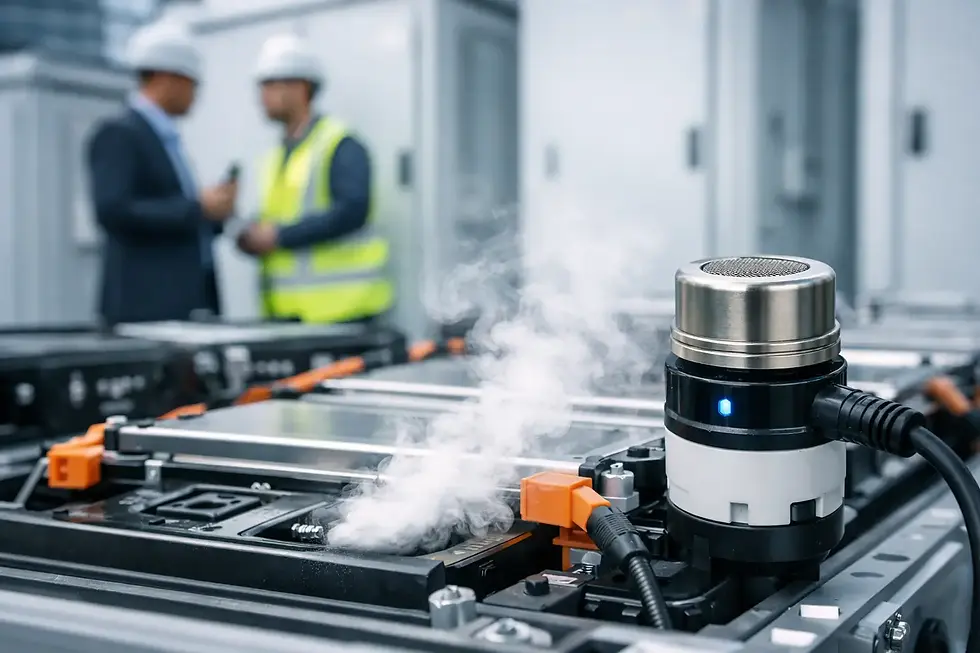
In practice, the strongest setups combine early petrol detection with BMS information, fire detection and pre-defined operational response. Specialist solutions such as the Evikon E2673 are built for this exact role, detecting hydrogen and electrolyte vapours in time to support intervention before ignition. For asset owners and project teams dealing with high-energy battery environments, that earlier warning can materially improve both safety outcomes and business continuity.
The real question is not whether a battery can fail. It is whether your site will know early enough to act while there is still time.


Comments