
Solar Battery Fire Risk Monitoring for BESS
- David Pugh

- 17 hours ago
- 5 min read
A battery container can appear normal while a lithium-ion cell is already entering a failure sequence. Long before visible smoke, flame or a fire alarm activation, a damaged or overstressed cell may release hydrogen, electrolyte vapours and volatile organic compounds. Effective solar battery fire risk monitoring is designed to identify these early indicators, giving operators time to isolate equipment, investigate the cause and activate a measured emergency response.
For solar farms, commercial energy storage and critical infrastructure, that early window matters. A thermal runaway event can threaten people, destroy high-value assets, interrupt generation or load support, and create a complex recovery process. Monitoring that begins only when heat or smoke is present may identify an incident after escalation has already begun.
Why solar battery fire risk monitoring needs an early-warning layer
Lithium-ion batteries are central to modern solar and energy storage projects, but their energy density also concentrates risk. Thermal runaway can be initiated by internal cell defects, mechanical damage, manufacturing faults, overcharging, external heating, cooling failure, electrical faults or ageing. The initiating cause varies, but the progression often follows a similar pattern: cell degradation, internal reactions, off-gassing, heat generation, smoke, fire and potentially propagation to adjacent cells or modules.
Battery management systems are essential. They supervise voltage, current, temperature and state of charge, and can identify many operating conditions that sit outside approved limits. However, a BMS does not directly measure every physical and chemical sign of cell failure. It may not detect a localised internal defect soon enough, particularly where readings remain within normal-looking ranges at pack or rack level.
Smoke and heat detection also have a place, but they are generally later-stage controls. By the time combustion products have reached a detector, response options may be more limited. Off-gas detection fills a critical gap by monitoring the atmosphere within or around the battery enclosure for the invisible precursors associated with failing lithium-ion cells.
This is not a replacement for a properly engineered BESS design, battery management system, ventilation strategy, fire protection system or emergency plan. It is an additional safety layer that improves situational awareness before the incident becomes a fire event.
What early-stage battery failure looks like
A lithium-ion battery does not always fail with an immediate, dramatic temperature rise. In many cases, internal chemical breakdown produces gases before smoke and flames occur. Depending on the cell chemistry, fault mode and enclosure conditions, early warning indicators can include hydrogen, VOCs, electrolyte vapours, changes in humidity and abnormal temperature trends.
Hydrogen is particularly relevant because it may be produced during battery failure and can accumulate in confined spaces. It is highly flammable at relatively low concentrations in air. Electrolyte vapours and VOCs can offer earlier evidence that a cell is venting or degrading, while humidity and temperature data provide useful contextual information for determining whether a developing condition is credible.
The value is not in one sensor reading alone. A well-designed monitoring approach evaluates multiple indicators and trends. This helps site teams distinguish a genuine developing fault from a temporary environmental change, while providing alarms early enough to support informed action.
Detection is only useful when it drives a response
An alarm without a defined response path is not risk control. Solar battery fire risk monitoring should be connected to site procedures that specify who is notified, what equipment may be isolated, how the area is made safe and when emergency services must be contacted.
For a utility-scale site, that response may include a SCADA alarm, remote operator notification, controlled shutdown of affected equipment, ventilation actions where appropriate, escalation to the asset owner and restrictions on personnel access. At a commercial installation, the response may need to account for building occupants, shared access areas and business continuity requirements.
The correct actions depend on the battery design, manufacturer guidance, enclosure layout, suppression approach and emergency management plan. Operators should avoid treating an early off-gas alarm as either automatic proof of fire or something to be ignored. It is a high-value warning that requires assessment under a rehearsed procedure.
Designing the monitoring system around the actual risk
There is no universal sensor placement rule that works for every solar battery installation. Containers, battery rooms, integrated cabinets and inverter-battery enclosures all behave differently. Airflow, ventilation, rack geometry, ceiling height, cable penetrations and likely gas migration paths affect where detection equipment should be installed.
In a BESS container, sensors are commonly positioned to capture gases where they are most likely to collect or travel, while remaining accessible for inspection and protected from physical damage. The detector must also suit the operating environment. Dust, condensation, high ambient temperatures, salt exposure in coastal regions and vibration can all influence equipment selection and installation design.
For larger or critical assets, the monitoring system should integrate cleanly with existing controls. Relay outputs can provide direct local alarm or interlock functions, while Modbus RTU compatibility supports data transfer to SCADA, a building management system or an energy management platform. This allows site teams to see alarm status alongside battery performance, HVAC data and other operational signals.
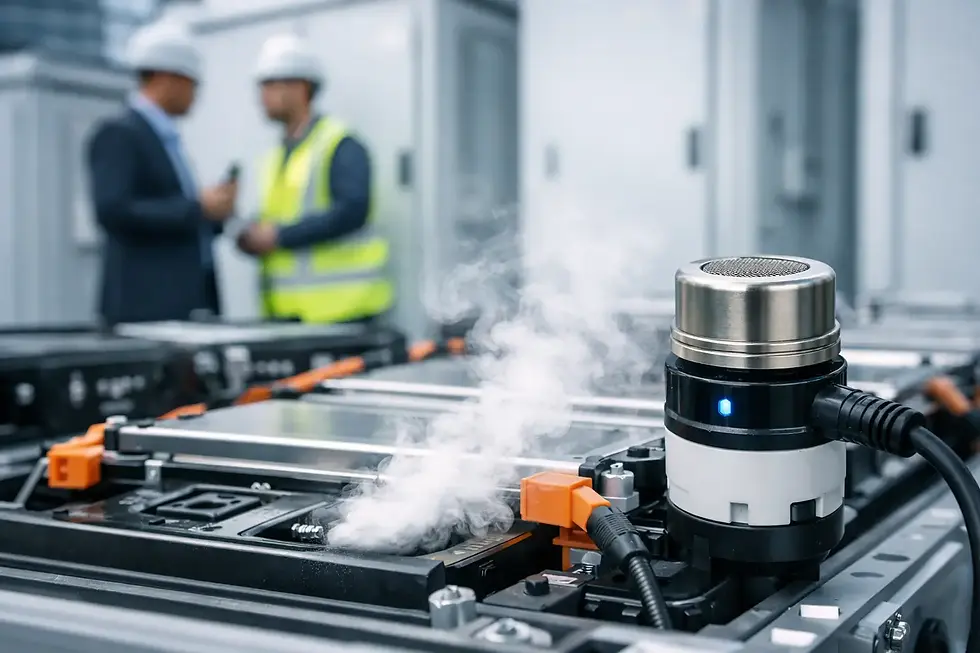
NexaGuard Systems supplies the Evikon E2673 industrial off-gassing detection system for applications where early warning, integration capability and compact installation are required. Monitoring hydrogen, VOCs, electrolyte vapours, humidity and temperature changes can provide a more complete indication of developing battery failure than relying on a single late-stage trigger.
Avoid treating compliance as the finish line
Compliance obligations, insurer requirements, manufacturer specifications and fire engineering recommendations should guide system design. They should not be viewed as a ceiling for risk management. BESS projects can meet baseline requirements while still leaving operators with limited early visibility of a cell-level failure.
The right monitoring strategy is proportionate to consequence. A small, isolated battery cabinet may need a different approach from a multi-megawatt solar farm BESS supplying a network support function. Likewise, a battery installation located near occupied buildings, essential services or high-value plant warrants closer consideration of escalation pathways and response time.
When assessing a solution, decision-makers should examine detection targets, response time, alarm thresholds, environmental suitability, communications protocols, expected service life, maintenance requirements and how the device will be tested after installation. They should also establish who owns alarm response across the lifecycle of the asset, including during unmanned or after-hours operation.
Monitoring supports uptime as well as safety
The business case for early detection is not limited to preventing fire damage. An off-gas event may indicate a battery fault that needs intervention before it causes wider module damage, forced shutdown or loss of capacity. Identifying the affected zone early can help maintenance teams investigate with better information and potentially reduce the scope of outage.
For developers, EPCs and asset owners, this has implications for availability, warranty management, insurance discussions and stakeholder confidence. For data centres, industrial sites and remote energy systems, it can protect continuity where battery storage supports critical loads or generation stability.
Early warning does not guarantee that every incident will be stopped. Some failure mechanisms progress rapidly, and no detection technology eliminates the need for sound engineering, quality equipment, disciplined maintenance and emergency preparedness. What it can do is improve the time available to make safer, more controlled decisions before smoke and flames define the situation.
A practical commissioning checklist
Before handing over a solar battery monitoring installation, confirm that the detection design reflects the final enclosure configuration rather than an early drawing set. Verify sensor locations, airflow assumptions, cabling, alarm setpoints and communications mapping. Functional testing should prove that alarms are visible at the local interface and at the nominated SCADA or control point.
Just as importantly, test the human side. Control room staff, facility managers and contractors need clear instructions for recognising an alarm, escalating it and maintaining a safe exclusion area. Records should identify inspection intervals, calibration or bump-test requirements where applicable, and the escalation contacts responsible for each site.
A battery fire rarely begins with a visible warning. Monitoring for the chemical signs that come first gives solar and BESS operators a meaningful chance to protect people, preserve assets and act while the situation is still manageable.


Comments