When Should Battery Gas Alarms Trigger Safely?
- David Pugh

- Jul 18
- 6 min read
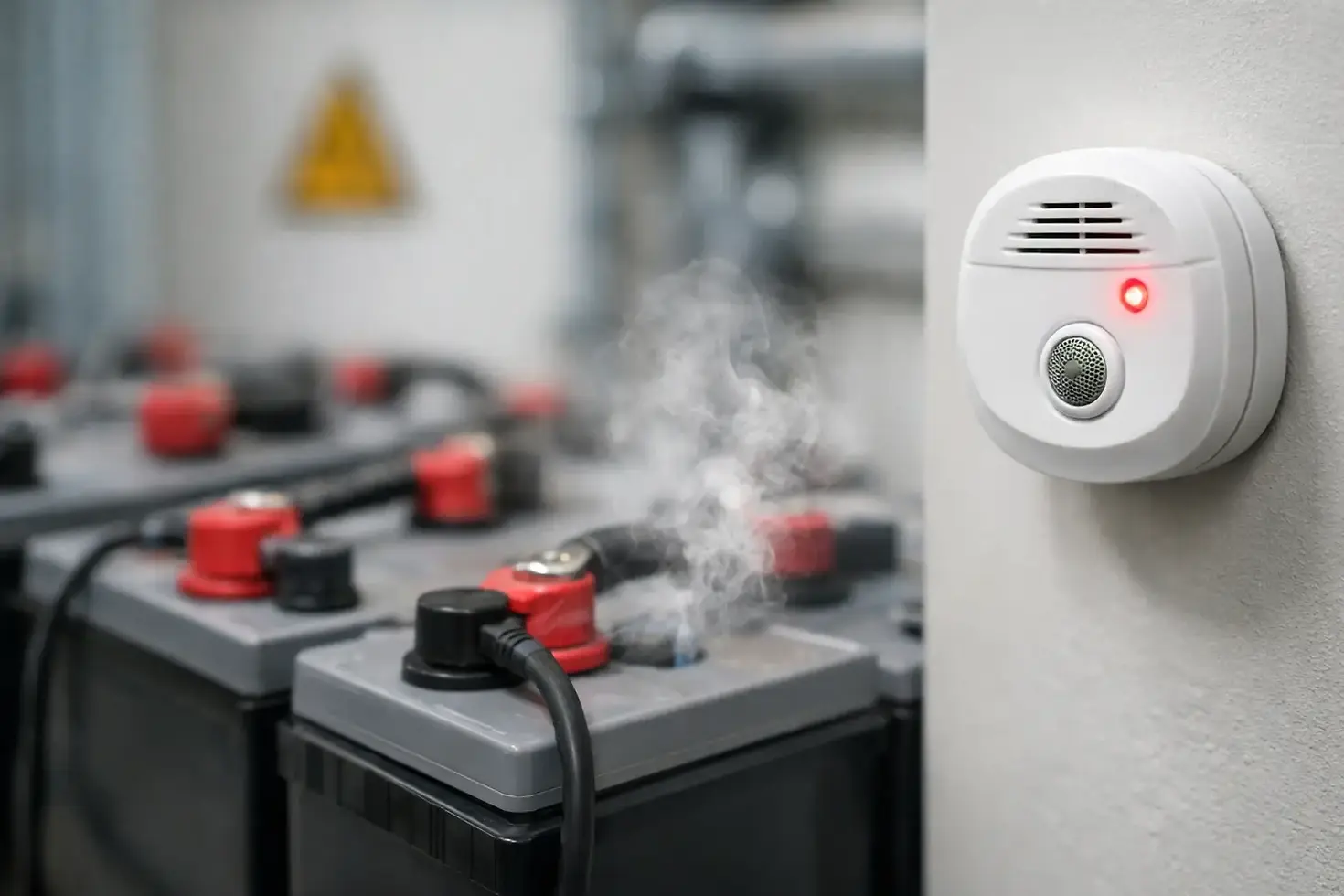
A lithium-ion battery can begin failing long before a conventional smoke detector responds. That creates a critical design question for asset owners and operators: when should battery gas alarms trigger? The answer is not when smoke becomes visible or when a battery enclosure is already hot. A properly engineered system should alarm at the earliest credible evidence of abnormal battery behaviour, then escalate response as the risk develops.
For BESS sites, UPS rooms, EV charging infrastructure and battery manufacturing environments, the objective is straightforward: detect danger before disaster. Gas alarm thresholds must provide enough warning to isolate affected equipment, investigate the event and protect people, assets and operational continuity.
Battery gas alarms should trigger before thermal runaway
Thermal runaway is a fast, self-heating failure process that can lead to venting, fire, explosion and toxic gas release. By the time flames, smoke or a high-temperature alarm appears, the incident may have progressed beyond the point where normal controls can prevent significant damage.
In many lithium-ion failure events, cells release gases and vapours during early degradation. Depending on the battery chemistry, state of charge and fault condition, these indicators may include hydrogen, volatile organic compounds (VOCs), electrolyte vapours and fine airborne particles. Changes in humidity and temperature can add useful context, particularly inside enclosed battery containers and electrical rooms.
This is why a battery gas alarm should not be configured as a simple fire alarm substitute. It is an early-warning layer. Its first alarm should identify an abnormal condition while operators still have practical options: verify the condition, stop charging or discharging, isolate the affected string or cabinet, increase ventilation where appropriate, and activate site-specific emergency procedures.
There is no universal alarm threshold
A single concentration setpoint cannot safely serve every lithium battery installation. The correct trigger level depends on the battery chemistry, enclosure size, ventilation rate, normal background gases, sensor type, airflow patterns and the actions available after an alarm.
For example, a tightly enclosed BESS cabinet may show a sharp local increase in hydrogen or electrolyte vapour from one failing module. A large containerised system with forced ventilation may dilute the same release, requiring careful sensor placement and trend analysis rather than reliance on one fixed reading. In a UPS room, low-level background VOCs from cleaning products, cable insulation or nearby equipment may influence the baseline.
The engineering principle is to trigger on a meaningful departure from normal conditions, not to wait for concentrations approaching flammability limits. Configuring an alarm near hydrogen's lower flammability limit is not early warning. It leaves little margin for changing ventilation conditions, sensor response time, gas stratification or rapid escalation.
Thresholds should therefore be established through a site-specific hazard assessment, battery manufacturer information, enclosure design and commissioning data. The alarm strategy needs to be documented and tested as part of the facility's broader emergency response and monitoring architecture.
Use staged alarms, not a single trip point
The most effective approach is a staged alarm philosophy. It distinguishes between an early abnormal signal, a confirmed developing fault and an immediate life-safety or asset-protection event. This reduces unnecessary shutdowns while ensuring a serious event is not missed.
Pre-alarm: investigate an abnormal trend
The first stage should activate when gas readings rise above the established baseline, or when multiple indicators show an unusual pattern. This may be a low-level increase in hydrogen, a VOC trend, an electrolyte vapour signal or a combination of gas, humidity and temperature changes.
At this point, the system should generate a local and remote notification through the building management system, SCADA platform or other supervisory control system. Operators can review battery management system data, inspect the relevant zone using safe procedures, confirm ventilation status and check whether charging, discharging or ambient conditions have changed.
A pre-alarm is particularly valuable because it prevents normal operational noise from being treated as an emergency while ensuring that a developing battery fault is not ignored.
Alarm: initiate controlled protective action
The second stage should trigger when gas concentration, rate of rise or a multi-sensor correlation indicates a credible battery fault. A sustained rise is usually more concerning than a short-lived spike, but this depends on the installation and sensor technology.
An alarm at this level may initiate a controlled shutdown of charging equipment, place the affected BESS in a safe state, isolate a battery rack, command additional ventilation, notify the control room and alert nominated emergency personnel. Relay outputs can support local interlocks, while Modbus RTU or equivalent communications can integrate gas data and alarm states into SCADA.
The response should be selective where possible. Shutting down an entire site from a low-confidence signal may create avoidable operational risk. Equally, allowing a suspected failure to remain connected because the shutdown logic is too conservative can turn a manageable event into an asset-loss event.
High-high alarm: treat the event as imminent escalation
A high-high alarm should indicate severe gas accumulation, a rapidly rising concentration, or corroborating evidence from temperature, humidity and battery management data. This condition requires immediate implementation of the site's emergency plan.
Actions may include emergency shutdown, isolation of relevant electrical systems, evacuation of defined areas, fire service notification and activation of site-specific ventilation or suppression controls. The exact sequence must be designed around the enclosure, fire strategy, electrical protection scheme and applicable regulatory requirements.
Automatic actions should never create a greater hazard. For example, ventilation can reduce gas accumulation in some scenarios, but may also affect fire and smoke management strategies. The system designer must assess those interactions rather than applying a generic response sequence.
What should cause an alarm to escalate?
The most reliable systems do not look at a single gas reading in isolation. Escalation should consider concentration, rate of rise, persistence and corroborating sensor inputs.
A small hydrogen increase that returns promptly to baseline may justify investigation but not shutdown. A repeated or sustained increase is more significant. A rapid rise in hydrogen combined with VOCs or electrolyte vapours, increasing humidity and an abnormal temperature trend is a much stronger indication that battery materials are breaking down.
This multi-parameter approach helps reduce nuisance alarms and strengthens incident confidence. It is especially useful in high-value infrastructure, where operators need evidence-based alarm decisions that protect both uptime and safety.
Sensor placement determines whether thresholds work
Even a well-chosen threshold can fail if the sensor is installed in the wrong location. Off-gases do not distribute evenly through a battery room or enclosure. Their movement is affected by gas density, temperature, forced airflow, cabinet geometry, extraction points and obstructions.
Sensors should be positioned where early releases are likely to accumulate or pass, based on the battery layout and ventilation design. This may mean installing detectors near battery cabinets, within containerised BESS enclosures, at high points where hydrogen may collect, or in return-air pathways. Large or compartmentalised installations may require multiple detection zones.
Commissioning should include baseline monitoring under ordinary operating conditions. Record readings across charge and discharge cycles, expected ambient temperatures and normal ventilation modes. These data provide the foundation for alarm settings that are sensitive enough to warn early without creating repeated false alarms.
Maintenance and integration are part of alarm reliability
Gas detection is only useful if it remains available when a fault occurs. Facilities should include detectors in inspection, functional-test and calibration schedules in accordance with the equipment manufacturer's requirements. Fault signals, communication loss and sensor end-of-life conditions should be visible to operators, not buried in a maintenance menu.
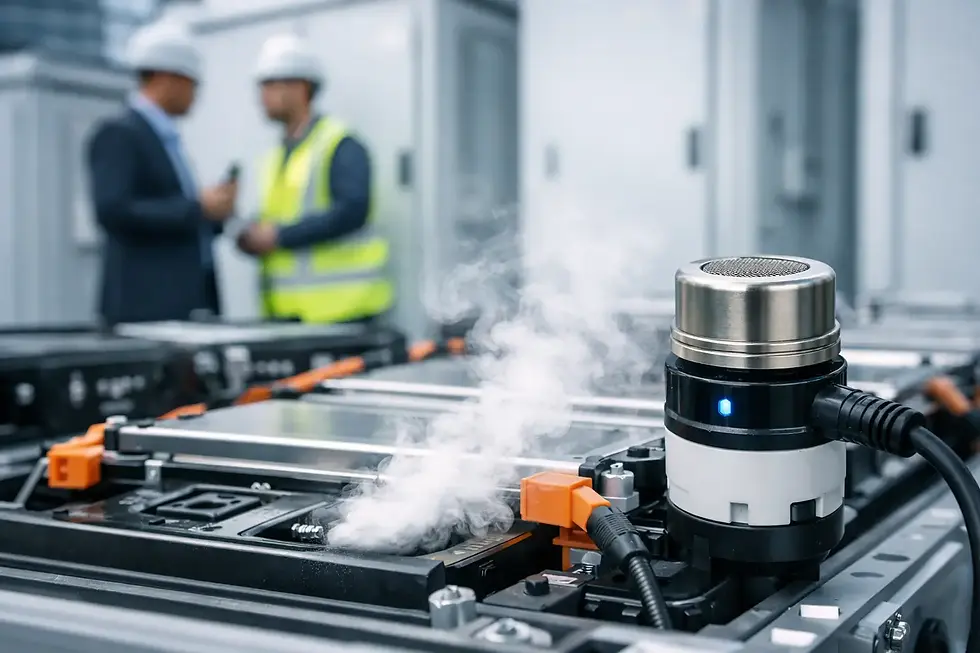
For industrial deployments, engineered off-gas systems such as the Evikon E2673 can provide monitoring for hydrogen, VOCs, electrolyte vapours, humidity and temperature, with relay outputs and Modbus RTU integration. This supports a layered response rather than relying on one late-stage indication.
Residential and small commercial settings require the same prevention mindset, even where full SCADA integration is unnecessary. An early-warning detector in a garage, workshop or EV charging area should alert occupants to abnormal battery off-gassing before smoke and fire develop, allowing them to move away, call emergency services if needed and avoid handling a visibly damaged or venting battery.
When should battery gas alarms trigger in practice?
Battery gas alarms should trigger at the first validated indication of abnormal off-gassing, not at the point of visible fire. They should then escalate as the evidence becomes stronger: from a low-level investigation alert, to controlled protective action, to an emergency response condition where concentrations or trends indicate imminent escalation.
The best threshold is therefore not simply a number on a specification sheet. It is a tested operating decision that connects early detection to clear action, appropriate isolation and reliable communication. In lithium battery environments, seconds matter, but the earlier minutes are where prevention has the greatest value.


Comments