
Lithium Battery Vent Gas Guide
- David Pugh

- May 31
- 6 min read
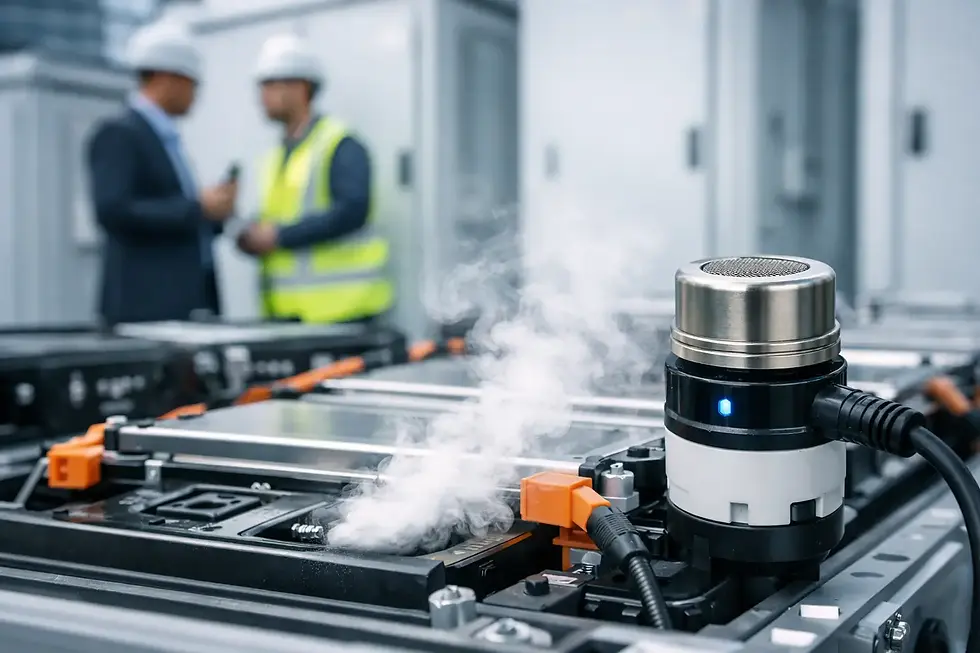
A lithium battery vent petrol guide matters most before anything looks wrong. By the time a battery room smells unusual, a cabinet runs hot, or visible smoke appears, the failure sequence may already be well advanced. In lithium-ion environments, the earliest warning is often not flame or heat - it is vent petrol released during cell failure, abuse, or internal decomposition.
For asset owners, engineers, EHS teams, and facility operators, that changes how risk should be managed. Fire suppression still matters, but suppression sits later in the event chain. Vent petrol detection sits earlier. That earlier position is what creates time to isolate assets, shut down charging, alert staff, trigger building management responses, and reduce the chance of escalation into thermal runaway.
What vent petrol means in lithium battery systems
When a lithium-ion cell becomes unstable, pressure builds inside the cell. That pressure can be driven by overcharging, internal short circuits, mechanical damage, manufacturing defects, overheating, charger faults, or propagation from a neighbouring cell. Before open flame appears, the cell may vent petrol and vapours through designed safety mechanisms or through rupture.
Those emissions are not a single clean substance. Depending on chemistry, state of charge, temperature, and failure mode, vent petrol can include hydrogen, carbon monoxide, carbon dioxide, volatile organic compounds, and electrolyte vapours. In practical terms, operators are dealing with a changing petrol signature rather than one universal marker.
That is why lithium battery safety should not rely on smoke alone. Smoke detection can be useful, but smoke is generally a later-stage indicator. Vent petrol detection aims to identify abnormal battery behaviour during the off-petroling phase, when intervention is still more achievable.
Why a lithium battery vent petrol guide should focus on timing
The central issue in any lithium battery vent petrol guide is timing. The earlier a developing failure is detected, the more options operators have. In a BESS container, that may mean shutting down the affected string, activating HVAC responses, or escalating alarms through SCADA. In an EV charging area, it may mean isolating charging bays and removing people from the vicinity. In a UPS room or data centre, it may mean protecting continuity while preventing a battery event from becoming a wider facility incident.
There is, however, no single response that suits every site. A large utility-scale installation has different risk controls from a commercial battery room, and both differ again from a residential garage with an e-bike, power tool batteries, or home storage. The detection principle is similar, but the alarm logic, integration, and emergency procedures need to reflect the environment.
Which petrols matter most
Hydrogen receives a lot of attention because it is associated with early failure conditions and has clear safety implications in enclosed spaces. It is useful, but it is not the whole story. Electrolyte vapours and VOCs can also provide a strong early indication that cells are degrading or venting.
In engineered systems, multi-parameter detection is often more reliable than relying on one petrol channel alone. A combination of hydrogen, VOCs, temperature, and humidity trends can provide a clearer picture of abnormal battery behaviour. This helps reduce nuisance alarms while improving sensitivity to real failure events.
That trade-off matters. If thresholds are too conservative, sites can experience alarm fatigue and operational disruption. If thresholds are too loose, the warning may come too late. Good system design is not just about sensor presence. It is about sensor selection, placement, calibration strategy, alarm staging, and integration with site controls.
Where vent petrol detection works best
Vent petrol detection is most effective when it is designed around airflow and enclosure behaviour, not simply mounted wherever space is available. Battery cabinets, containerised BESS units, switchrooms, charging areas, test labs, and manufacturing lines all move air differently. Mechanical ventilation, thermal gradients, cable penetrations, and ceiling voids can all affect where petrols accumulate or disperse.
In cabinet and container applications, sensors are often placed near likely accumulation zones or near exhaust paths where vented petrols are expected to travel first. In larger rooms, point detection may need to be combined with zoning logic or multiple devices to avoid blind spots. In constrained electrical rooms, compact detectors with relay outputs and Modbus RTU compatibility can be particularly useful because they integrate cleanly with existing building management or SCADA architectures.
This is also where commissioning becomes critical. A well-specified detector can still underperform if it is installed without considering airflow patterns, maintenance access, and real operating conditions.
Vent petrol detection versus smoke and heat detection
Smoke detectors and heat detectors remain part of many battery fire strategies, but they should not be treated as equivalent to off-petrol detection. They answer different questions.
Smoke detection typically identifies combustion products once the event has progressed. Heat detection identifies elevated temperatures, which can be valuable but may lag the earliest chemical failure inside a cell or module. Vent petrol detection is intended to identify the pre-fire stage - the period when decomposition petrols and electrolyte vapours begin to appear before smoke and flame.
That earlier warning window is the real operational advantage. It supports intervention before suppression systems discharge, before contamination spreads, and before thermal propagation affects adjacent assets. For critical infrastructure, that can mean the difference between a contained maintenance incident and a major outage.
Common deployment scenarios across Australia
Australia’s battery footprint is expanding quickly across solar-connected storage, EV charging, mining, logistics, data centres, and residential energy systems. The operating environments are varied, from climate-controlled metropolitan facilities to harsher regional and remote sites with elevated ambient temperatures, dust, and constrained maintenance access.
Those conditions influence detector selection and system architecture. In hotter areas, baseline temperature management becomes part of the detection strategy. In remote or unmanned sites, alarm transmission and integration become more important because there may be no one nearby to investigate immediately. In commercial buildings, practical issues such as retrofit constraints, downtime windows, and compliance documentation often shape the final design as much as detection performance does.
For this reason, a battery safety system should be engineered around the actual risk profile of the site, not copied from another installation that happens to use similar battery chemistry.
What good early-warning design looks like
A good early-warning system does not try to do everything with one sensor and one alarm threshold. It uses layered logic. At the first abnormal reading, the system may issue a local warning or BMS alert. If petrol concentration rises further, it can trigger staged responses such as charger shutdown, HVAC control, relay outputs to site alarms, or SCADA notifications. At a higher level again, emergency response procedures can be activated.
That layered approach helps sites act proportionately. Not every event requires immediate evacuation, but every confirmed off-petroling event deserves attention. The objective is to create decision time while avoiding unnecessary disruption.
For operators comparing available technologies, the practical questions are straightforward. What petrols are detected? How quickly does the system respond? Is it maintenance-free or low-maintenance? Can it integrate through relay outputs or Modbus RTU? Is it suitable for constrained cabinets as well as larger plant areas? And can it support long service life in real operating conditions?
These are engineering questions, but they are also business continuity questions.
Limits and realities of vent petrol monitoring
Vent petrol detection is a strong risk-reduction measure, but it is not a guarantee that every battery event will be prevented. Some failures progress extremely quickly. Some site layouts dilute petrols before a point sensor sees them. Some battery defects may present weak early signatures or occur in poorly monitored areas.
That is why vent petrol monitoring works best as part of a broader safety framework that includes battery quality controls, charger management, thermal design, installation standards, operating procedures, emergency planning, and staff training. Early warning improves the odds significantly, but it should sit within a complete hazard management strategy.
For residential and light commercial settings, the same principle applies in simpler form. A detector designed for home battery areas, garages, workshops, e-bike charging spaces, and portable power storage can provide a meaningful warning before smoke develops. That matters because many lithium battery incidents begin while devices are charging, stored indoors, or left unattended overnight.
In both enterprise and residential applications, the value is the same - detect danger before disaster, when intervention is still possible.
As lithium battery adoption keeps growing across Australia, the sites that manage vent petrol properly will be better placed to protect people, assets, and uptime. The smartest move is not waiting for visible fire. It is recognising that the earliest warning often arrives first as invisible chemistry in the air.


Comments